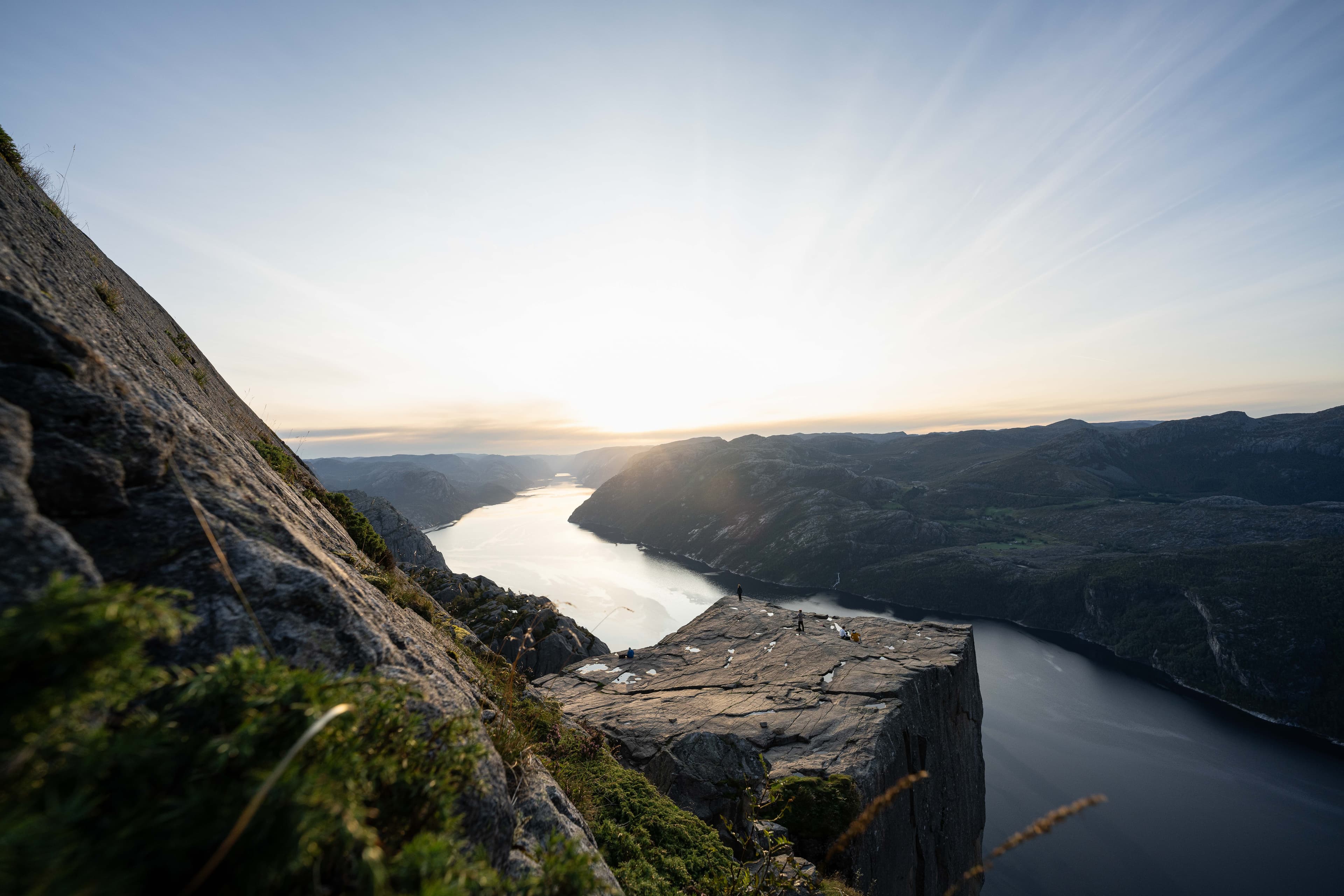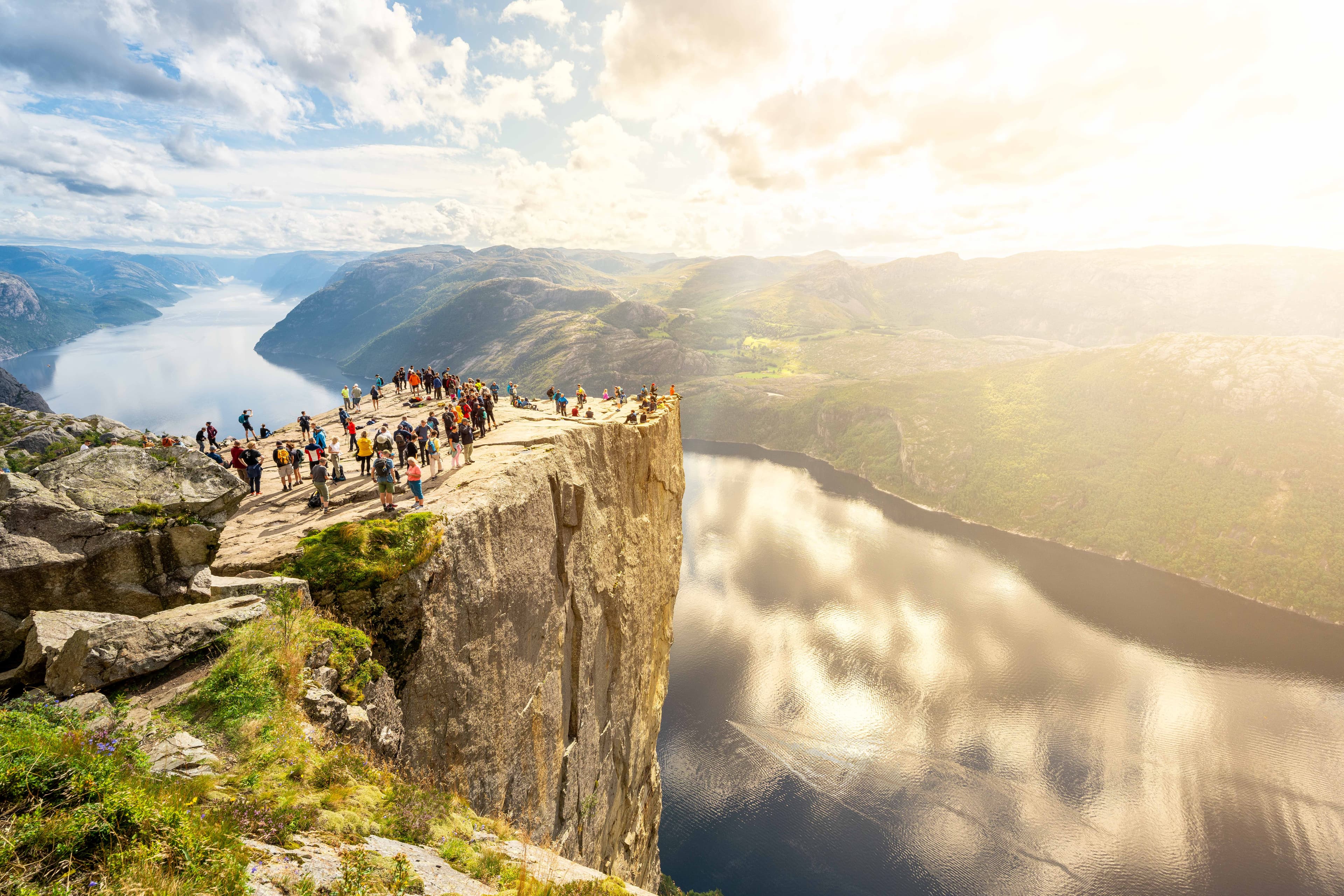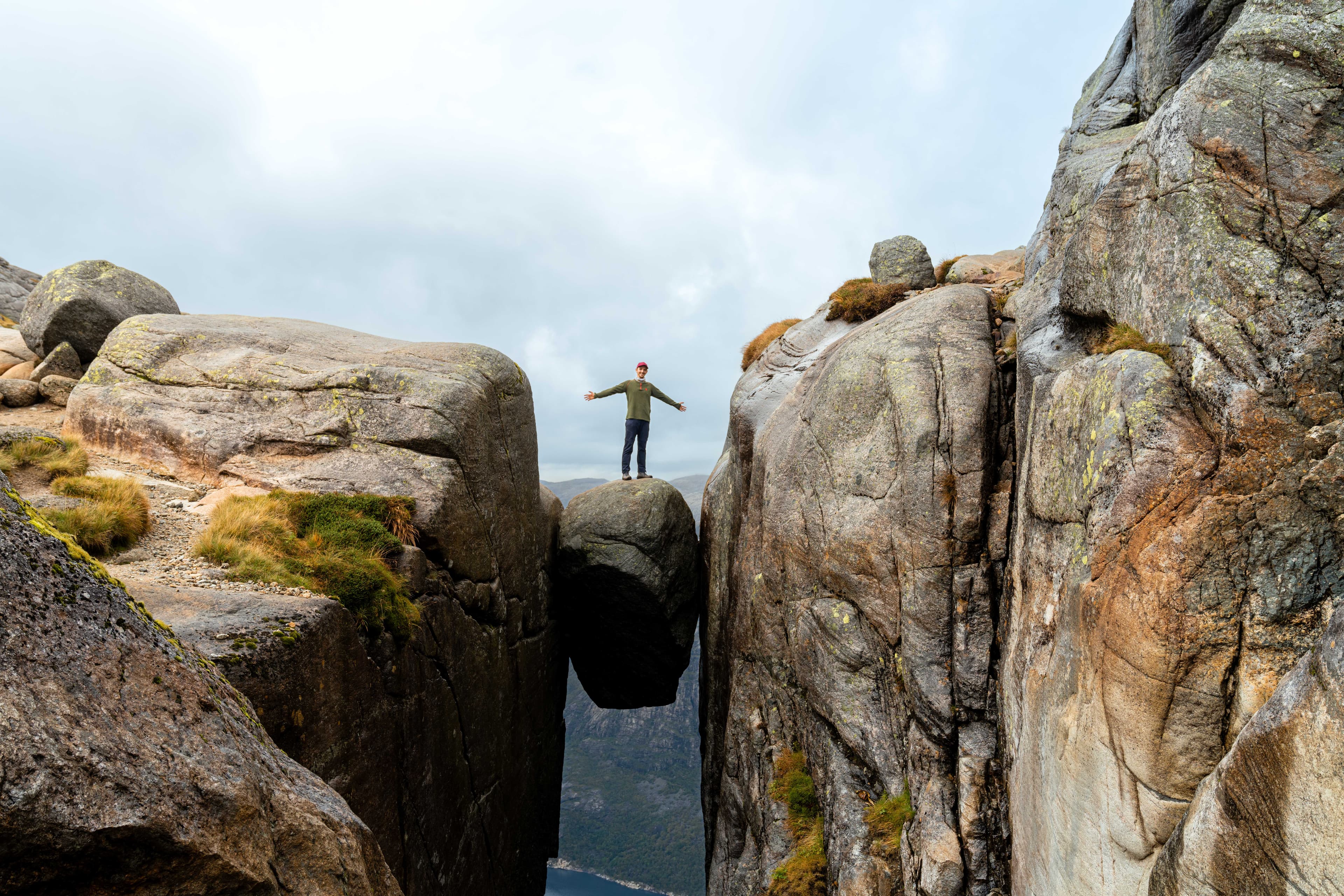
Kjeragbolten has stood here for ten thousand years, wedged in a crack in the mountain since the last glaciers retreated. Five cubic meters of granite, deposited by ice and held in place by the perfect geometry of friction and weight. It has become one of Norway's most photographed places, but the journey to reach it is what changes you.
The Trail
The numbers tell part of the story. Ten kilometers of walking. Seven hundred and fifty meters of climbing. Six to seven hours on the mountain, plus the travel to get there. From Stavanger, the full day stretches to eleven or thirteen hours, depending on ferries and roads.
The trail begins at Øygardstølen, a parking area perched on the mountainside. The first section climbs steeply through broken terrain, stone steps carved into the slope, the kind of walking that makes your thighs burn and your lungs search for air. The first two hours are relentless. You gain elevation quickly, leaving the trees behind, entering a world of rock and sky.
Then the plateau opens up. The angle eases. You find yourself walking across a landscape scraped clean by ancient ice, with views that extend to the horizon. Three small lakes appear, their water so still it mirrors the clouds passing overhead. The hardest part is behind you, but the mountain is not finished testing your resolve.
This is a challenging hike, not a Sunday stroll. The exposure to height is constant. The weather can shift from sunshine to fog in the span of an hour. Those who come prepared, who have trained their bodies and respect the mountain, find the effort rewarded. Those who underestimate the trail often turn back before they ever see the boulder.
What you see along the way
The landscape here feels borrowed from another planet. No soil to speak of, just granite worn smooth by ice and time. Patches of snow linger in hollows even in late summer, refusing to surrender to the sun.
Life persists despite the harshness. Reindeer move across the plateau in small groups, their coats changing with the seasons, their movements unhurried. Arctic foxes have been seen here, though they vanish like smoke when humans approach. Golden eagles ride the thermals rising from the fjord below, their shadows racing across the stone as they circle overhead.
The silence is profound. Without trees to rustle, without streams to babble, the only sounds are wind and your own footsteps on rock. It is the kind of silence that makes you aware of your own heartbeat, your own breathing, your own smallness in the vastness of the landscape.
When to go
The season begins in mid-May, when the snow finally releases its grip on the high ground. The trail emerges from its winter sleep, wet and muddy at first, then drying as the days lengthen. This is a quiet time, before the summer crowds arrive.
June and July bring the most reliable conditions. The snow has retreated to the highest peaks. The days are long, stretching toward midnight, and the weather is at its most stable. This is also when you will share the trail with others drawn to the challenge, when the plateau feels like a gathering of kindred spirits.
August shifts the mood. The light becomes softer, more golden. Afternoon storms are more common, brief explosions of rain and wind that pass as quickly as they arrive. The crowds begin to thin as the month progresses, and those who remain sense the turning of the season.
September transforms the mountain. The first snow returns, dusting the peaks overnight, melting in the morning sun. The temperature drops. Those who hike now understand that they are borrowing time from winter, that every clear day is a gift to be appreciated.
October brings the last hikers of the year. The rowan berries turn brilliant red against the gray stone. Frost covers the ground in the mornings. The weather becomes unpredictable, capable of sunshine or snowstorm with little warning. Only those with experience in mountain conditions should attempt the trail now.
What to bring
Your feet are your foundation. Boots with solid ankle support are essential on the uneven granite that makes up most of the trail.
Layer your clothing. The temperature can vary by ten degrees between the trailhead and the boulder. Start with a base layer that moves moisture away from your skin. Add a mid-layer for insulation. Finish with a shell that blocks wind and sheds rain.
Carry two liters of water minimum. There are no streams to refill from on the plateau. Bring food you actually want to eat when you are tired and hungry, not just energy bars. Chocolate, nuts, a proper sandwich. You will burn through calories faster than you expect.
Pack a headlamp even in midsummer. Pack an emergency blanket even on the clearest day. They weigh almost nothing. They can matter enormously.
On safety
The Norwegian mountains do not forgive carelessness. They demand respect, and they reward those who give it.
Watch the weather. A morning that begins with blue skies can turn to fog and driving rain by afternoon. Check the forecast before you leave. Be willing to turn around if conditions deteriorate. The boulder will still be there tomorrow.
Approach the boulder with caution. The drop is immediate and absolute. There is no gentle slope, no warning zone. One moment you are on solid rock, the next you are looking down a thousand meters of vertical air. Step carefully. Move slowly. Keep your weight centered. Do not attempt the boulder in wet or windy conditions, no matter how much you want the photograph.
Prepare your body. Train on hills in the weeks before your trip. Build your endurance. Get comfortable with long days on your feet. The mountain will test you. Your preparation determines whether you pass.
How it was formed
The story of Kjeragbolten is written in ice.
During the last Ice Age, massive glaciers covered this landscape, advancing and retreating over millennia. The freeze-thaw cycle cracked the granite bedrock, opening fractures and weaknesses. As the climate warmed and the ice began its final retreat, some ten thousand years ago, it carried this boulder with it, depositing it in a crack on the mountainside.
Chance and physics did the rest. The boulder settled into a position where friction and gravity balance perfectly. It has remained there ever since, through storms and earthquakes and the slow passing of centuries, held in place by nothing more than the geometry of the stone.
Photographing the boulder
Every visitor wants the photograph. The image of a person standing on that suspended rock, a thousand meters of void beneath their feet, has circled the world.
To capture it well requires patience. Morning and evening offer the kindest light, soft and golden, without the harsh shadows of midday. A wide-angle lens helps convey the scale of the landscape. Position yourself carefully, frame the shot thoughtfully, and wait for the right moment when the light and the clouds align.
Consider alternative perspectives as well. The approach from the side reveals the true scale of the drop. Close-up details of the rock surface show the texture and age of the stone. The landscape surrounding the boulder is as worthy of attention as the boulder itself.
Leave your drone at home. They are prohibited here, and for good reason. The peace of the mountain deserves protection.
""I have guided hundreds of people to Kjeragbolten over the years. I have watched them approach that boulder with fear, with excitement, with disbelief. And I have noticed something. The ones who get the most from this place are not the ones who rush to stand on the rock for a photograph. They are the ones who take their time on the trail, who pause to watch the eagles, who let the silence sink in. We have a word in Norwegian, friluftsliv. It means open-air living. It is about the relationship between yourself and the landscape, not about checking items off a list." — Aleksander Omtvedt, Lead Guide A few practical notes The journey begins at Øygardstølen, a trailhead two and a half hours from Stavanger by road and ferry. The drive itself is part of the experience, winding along fjords and through tunnels carved into the mountain. Parking is available but limited, and the final approach road is narrow. Guided trips simplify the logistics. Transport is arranged. Equipment is provided. Safety briefings prepare you for what lies ahead. You walk with someone who knows the mountain intimately, who can read the weather and the trail conditions, who can share stories that deepen your understanding of the place."
The mountain was here long before humans walked the earth. It will remain long after we are gone. Kjeragbolten does not need visitors. It does not want anything from us.
But if you choose to make the journey, if you walk the ten kilometers and climb the seven hundred and fifty meters, if you stand on that impossible stone and feel the vastness of the landscape and the smallness of yourself, you may find something worth the effort.
Not comfort. Not ease. The understanding that you stood at the edge of the world and did not look away.
Kjeragbolten is waiting. The question is whether you are ready.